Capability
What Innov8 does, and the method underneath it.
The intent is one live, connected source of truth across the systems and the parties. This is the capability that delivers it, and the method it runs on. The page doubles as the practice capability statement.
The Infrastructure Platform Evolution Model
Innov8 treats transformation as a control system rather than a project. The model runs a continuous loop with two hard governance gates.
- Business outcome. What the organisation must protect while change happens. Anchored in operating-window discipline.
- Telemetry baseline. Use the monitoring, CMDB, ticketing and identity systems that already exist to establish what is known about the estate before commissioning any new work.
- Discovery. Build the operational and physical model. Telemetry first, then targeted site capture for the physical layer.
- Definition. Standards, specifications, reference architectures and fit-for-purpose requirements.
- C1, Architecture Control. The design gate. Confirms the proposed solution aligns with platform standards and business outcomes before further investment is committed. Over time the pattern of C1 decisions is the architecture vision.
- Validation lab. Near-real-world testing. New technology meets the platform here before it meets production.
- C2, Deployment Control. The release gate. Confirms rollout sequencing, operational readiness and risk controls before execution.
- Execution. Controlled rollout across the estate.
- Operational protection. Monitoring, incident readiness, rollback planning and active risk control while change is live.
- Telemetry and feedback. Production behaviour feeds back into the lab and refines the standards.
New technology should meet the platform in the lab before it meets the business in production.
Coverage, Capacity, Capability
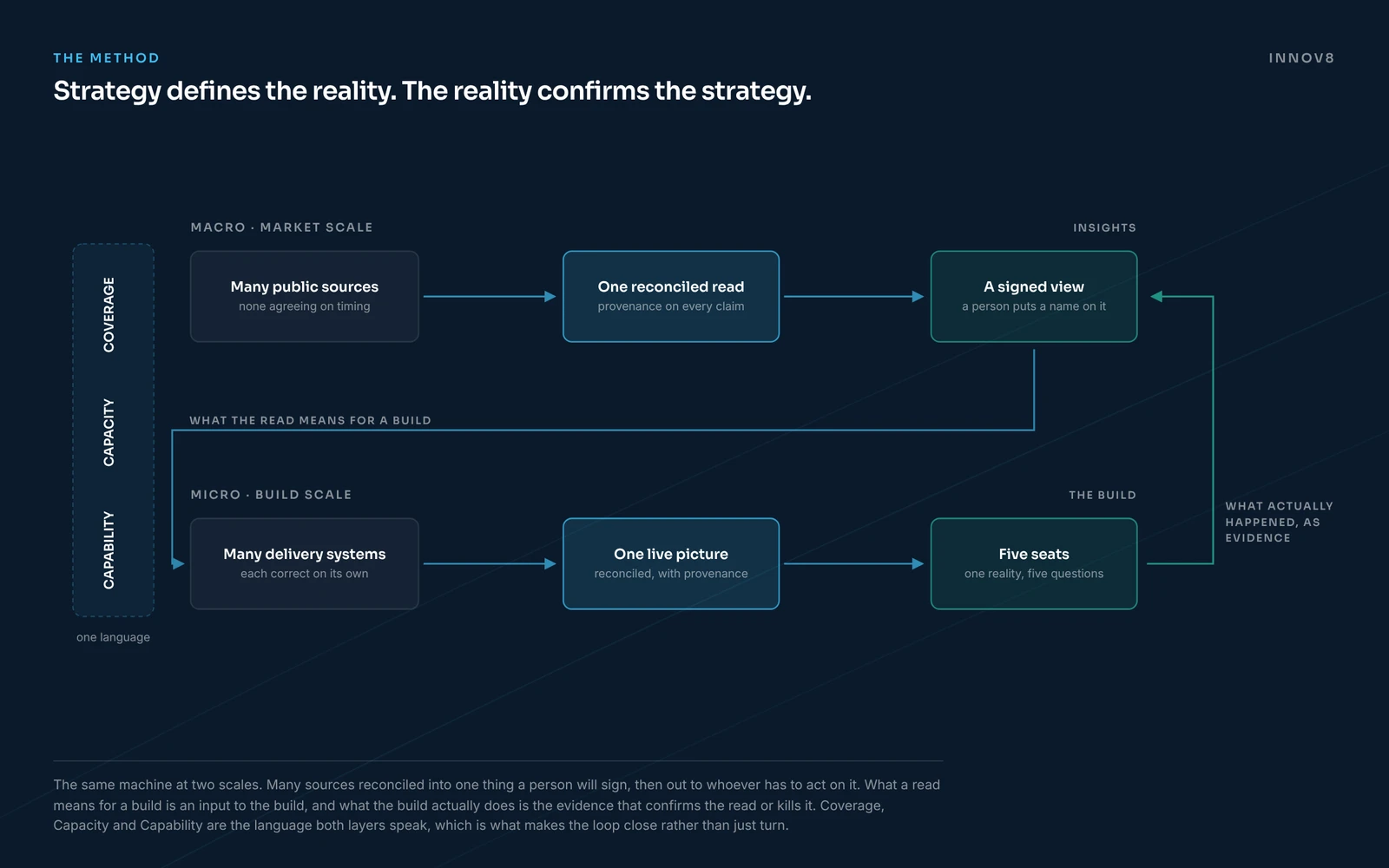
The same machine at two scales. What a read means for a build is an input to the build, and what the build actually does is the evidence that confirms the read or kills it.
The 3Cs are the normalising framework applied at every layer of the platform and at every stage of the lifecycle. They give architects, engineers and executives a shared language for the same question.
Coverage
Does the platform exist everywhere the business needs it? Which sites, channels, brands, products and geographies are served, and where are the gaps?
Capacity
Can the platform carry the workload? What is the headroom before degradation, and where does the next launch or seasonal peak break it?
Capability
Can the platform deliver the function required? What can it do, what can it not do, and what can the organisation not yet evidence to a regulator?
Applied consistently across discovery, design, validation, deployment, operations and planning.
Capability areas
Connected sources of truth
Each layer of a delivery connected, from the physical infrastructure up through the cloud, and integrated with the tools that layer already runs on: the element and infrastructure management systems, the project and delivery tools, the CMDB, the operations tooling, the telemetry. Every connection adds another source of truth and another live status.
The same principle extended to the supply chain, both the equipment, through procurement and logistics, and the resources, through people, skills and availability, and across the parties who own each part. Clear roles, responsibilities, inputs and outputs across organisational boundaries, so a dozen contracted parties operate as one delivery team against one picture.
Innov8 acts as the architect, not the vendor. For each capability the delivery actually needs, the call is build it, buy it, or integrate what is already there. An incumbent platform running the CMDB and change is a component to build on, not something to replace. Nothing gets thrown away.
The design thread stays alive with it, the high and low level designs becoming a living bill of materials, assemblies, tests and controls, rather than static documents that are true only on the day they are signed.
Data centre and network programme delivery
Buildout, consolidation, relocation and migration across greenfield and brownfield estates, multi-site and multi-vendor. Full stack, covering network, compute, storage, power (PDU, UPS, DRUPS, STS, ATS), cooling and structured cabling.
Includes forensic physical audit at device level, DCIM implementation and population, rack and pathway modelling, and operations handover with training.
Transformation and migration in live environments
Delivery of change into production without service disruption. Commissioning, acceptance and cutover discipline, dual-run periods and formal acceptance before any legacy platform is retired.
Applied across carrier, clinical, exchange, port, venue and government environments where service continuity is not negotiable.
Standards authorship and operating-model design
Innov8 authors the standard, then designs the governance that makes it stick.
Documented standards work includes the ICT cabling standard for new and refurbished health facilities across an entire state health system, taken through four major revisions plus a remediation design guide; the data centre standard for category 1 and 2 sites for a second state health system, alongside that system's cabling standard; a government tenant data centre manual for a whole-of-government data centre estate; a data centre standard for a national telecommunications carrier; and the full service specification suites behind a statewide health network programme and a statewide unified communications programme, covering wired, wireless, distributed antenna, campus LAN, SIP core and trunk, carrier connectivity, endpoints, secure messaging and mobility.
Alongside the standards: commissioning frameworks, facility integration matrices, site classification models, service zone selection guides and the stage-gate governance that enforces them, where design is certified before build and deployment is certified before operate.
The point of authorship is not the document. It is that the standard survives the programme that created it.
Commercial design, both sides of the table
Client-side: business case authorship including Treasury-grade financial modelling, RFT and tender documentation, consumption and as-a-service cost models, multi-tier pricing across a distributed estate, and independent cost assurance on infrastructure capital.
Integrator-side: leading the technical and commercial response, pricing structure, partnership architecture and proposal governance.
Having done both is the point. Commercial structures designed with only one side in view tend not to survive delivery.
Structured discovery and estate modelling
Most transformation programmes start without an accurate picture of the estate. Innov8 uses a telemetry-led method that draws on existing monitoring, asset and ticketing systems to build an initial model before any site work begins, then targets physical audit only where it is genuinely required.
The approach reduces site visits, shortens the discovery phase and surfaces undocumented dependencies early, when they are still cheap.
Operational separation and carve-out
Separation and carve-out methodology for large distributed estates, governing the stand-up of independent technology operations under transitional services arrangements, with the same gate discipline applied to trading continuity.
Differentiator
AI-enabled delivery
Innov8 runs AI in production, under the same governance the infrastructure work uses. The claim is not that AI is interesting. The claim is that it can be made accountable.
Signals versus decisions
General-purpose AI reads telemetry, configuration and service data and produces insight, gap analysis and remediation options. That is useful, and it is not a decision. It has no accountability, no standard to test against and no audit trail.
Inside a control system, AI is positioned differently. It monitors compliance continuously against embedded standards, simulates rollout and impact scenarios, and supports sequencing decisions inside the C1 and C2 gates, where a human owns the outcome and the reasoning is recorded.
Generic AI provides signals. AI inside the control system supports decisions that are accountable and auditable.
What the engineering discipline looks like
The interesting part is not that AI is in the loop. It is what happens when it fails.
Failed analyses are dead-lettered rather than retried indefinitely, because an unbounded retry loop on paid inference is a cost incident waiting to happen. That one was learned the hard way, when a nightly job turned out to be spending most of a build budget reprocessing the same unreadable files for no progress. The fix was a dead-letter state, a sentinel for the unprocessable, and a cadence change.
Inference spend runs against a hard monthly cap with the cheaper model as default. Every derived fact carries provenance recording which source produced it and when, so conflicting sources resolve by documented hierarchy rather than by whichever job ran last. Nothing touching a person's likeness publishes without human review. Nothing changes a financial record without human approval.
That is the same posture applied to any production platform. AI does not get an exemption.
What this means for a client
Most organisations are being asked whether they are ready to deploy AI across operational platforms. It is usually the wrong question first. The prior question is whether the underlying platform has the coverage, capacity and capability to carry it, and whether there is a governance model that will hold once it is live.
Innov8 has built and run the answer, not just written the paper.
Microsoft Cloud Partner
Innov8 is a member of the Microsoft Cloud Partner Program, with access to the full Microsoft platform stack, licensing pathways, technical resources and product roadmap.
In practice that means engagements can be delivered on Azure and Microsoft 365 without a separate vendor relationship being stood up first, and that architecture recommendations are made by someone who runs the stack rather than someone who has read about it.
Three production platforms run on it today, plus this site. Azure Static Web Apps for delivery, SharePoint as a data layer, Power Automate for orchestration, Azure Functions for services, Azure Blob for asset storage, Entra for identity and role-based access, and GitHub Actions for builds and scheduled jobs.
Partner status sits alongside the AI work rather than separate from it. Governed AI has to run somewhere, and it has to be somewhere with identity, compliance and audit already solved.
How engagements are structured
- Advisory. Business case, strategy, target-state definition, standards, commercial design. Typically weeks to a few months.
- Programme leadership. Technical programme management, governance gate ownership, vendor and delivery-partner control across concurrent workstreams. Typically multi-year.
- Methodology lead through a prime. Innov8 provides the method, standards and technical governance while a prime contractor holds the delivery contract. Existing prime relationships include Nexon, Fujitsu, Avantex and ASV Platforms.
- Assessment and readiness. Estate audit, DCIM implementation, readiness assessment against a planned initiative, operations handover.
- Senior contract and interim. Contracted through Innov8, bringing the method and the standards rather than a body against a role description.
- Onboarded as a Head of or a VP. The same intent taken inside, with short and long-term incentives, where the shape that suits the client is a senior-role mandate rather than a consulting engagement.
There is no SKU and no licence fee, because it is not software. It is engaged, contracted, run pay-as-you-go, or hired. The client chooses the shape.