Platforms
Three production systems built and operated by Innov8.
They exist because architecture claims are cheap and running systems are not.
Why this page exists
Every technology practice currently claims AI capability. Very little of it is running anywhere with real users, a real compliance obligation and a real cost ceiling.
These three are. Two are complete operating platforms for community organisations, which turns out to be a hard architecture problem wearing a soft hat. There is no budget, so every component has to come from a grant tier or a permanent free tier. There is no IT team, so nothing can require a developer to operate. The users are volunteers who did not sign up for software, so the interface has to be something they already use. There is genuine compliance exposure, because a missing working-with-children check before a match is both a forfeit and a safeguarding failure. And there is real privacy sensitivity, because most of the people in the system are children.
Constraints like that force honest architecture. There is nowhere to hide a licence cost or a manual workaround.
The third is the practice's own financial operating system, which is the same discipline applied where the consequence of getting it wrong is a misstated set of accounts.
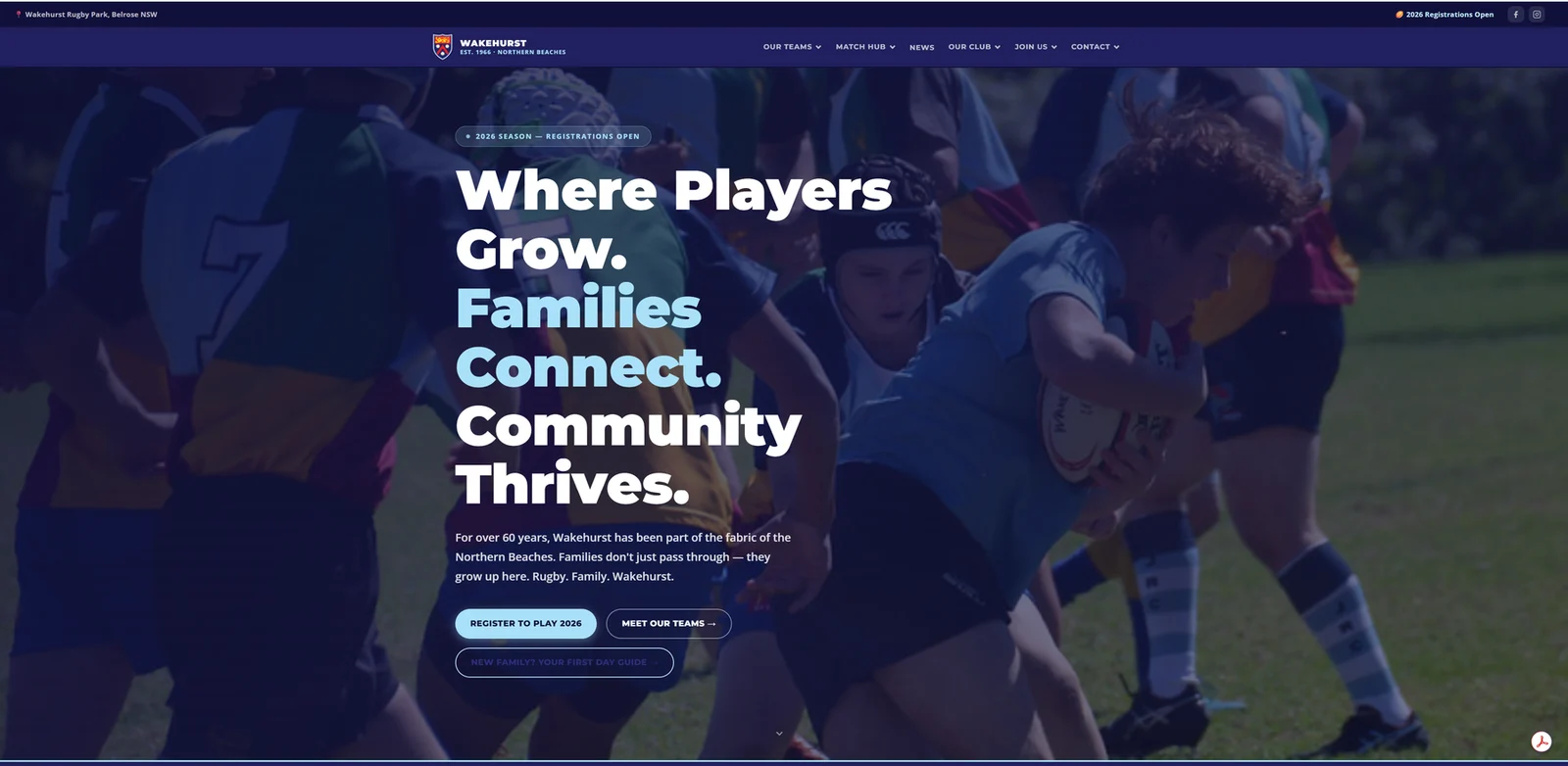
Wakehurst Rugby Club
A complete digital club operating system, running on what the club already pays for.
The problem
The club ran on volunteer effort and a master spreadsheet. Registrations lived in one person's file. Compliance evidence lived in email searches. There was no central record of who the club's members were or had been. The website could only be changed by someone who could write code.
That works until it does not. A missed working-with-children check before a match is a forfeit. A late early-bird payment erodes member goodwill. A coach listed incorrectly means a parent calls the wrong person. These were weekly costs in volunteer time.
What was built
A single member database
Every person who has had a relationship with the club, consolidated from years of registration exports plus an archaeology pass across historical records reaching back to the club's founding. Every record carries a stable member identifier and a provenance record showing which source produced each fact and when, so competing sources resolve by documented hierarchy rather than by whichever job ran last.
A compliance system
Accreditation reports are ingested weekly and matched against the competition's minimum requirements per team type, which are stored as configuration rather than code so they can change each season without a developer. Every Monday morning an automated digest tells the registrar and the compliance officer which teams have gaps, colour-coded by risk. Expiring accreditations are flagged before they expire.
A media pipeline
Claude Vision analyses and describes the club's image library, with face detection for member matching. Nothing involving a person's likeness publishes without passing a human review gate, and the consent model is explicit rather than assumed.
Automated match reporting
Fixture and result data is drawn from the governing body's systems and turned into published match reports without a volunteer writing them.
A finals tool
For every junior competition, the live ladder, remaining fixtures, best and worst possible finish, whether a semi-final is still mathematically possible or already secured, and card tallies against the competition's disciplinary thresholds. Built because managers were working it out on paper.
Rewards and payments
Registration incentives issued automatically through a payment provider's gift card API, with a one-click approval step.
Publishing by email
An approved contributor publishes a news article by sending an email. The system checks the sender is recognised, routes unknown senders for approval, and publishes. Nobody logs into a content management system.
A digital heritage edition
The club's written history published as a digital edition with three views over one dataset, wired to the scanned primary-source documents behind every citation.
How it is built
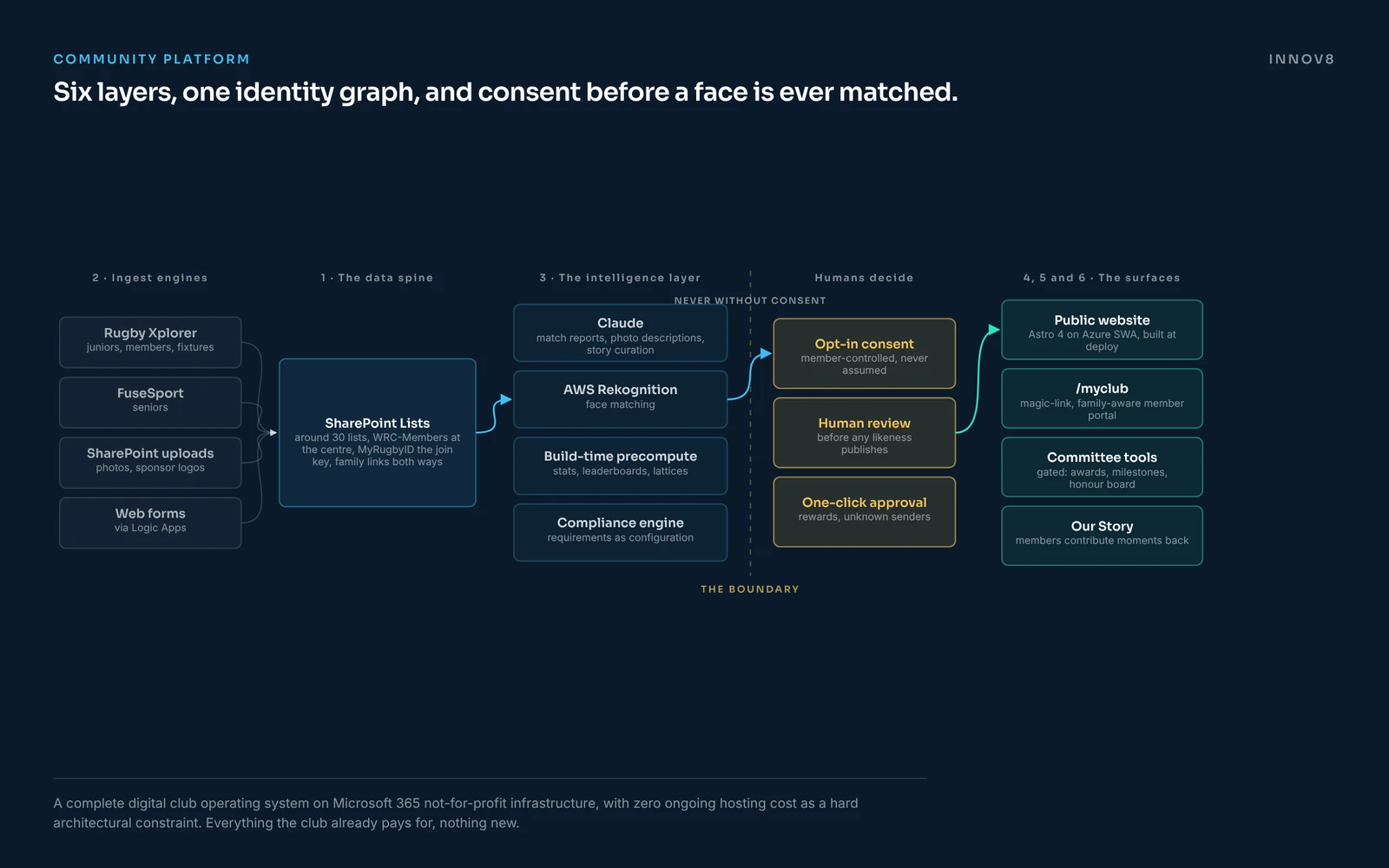
The layers, the identity graph, and the consent gate before any likeness is matched.
Microsoft 365 and SharePoint as the data layer on the club's existing not-for-profit grant. Astro on Azure Static Web Apps for the public site. Power Automate for orchestration. Azure Blob for archive assets. GitHub Actions for builds and scheduled jobs. Claude for the AI layer, with a hard monthly spend cap. Total ongoing platform cost: nothing.
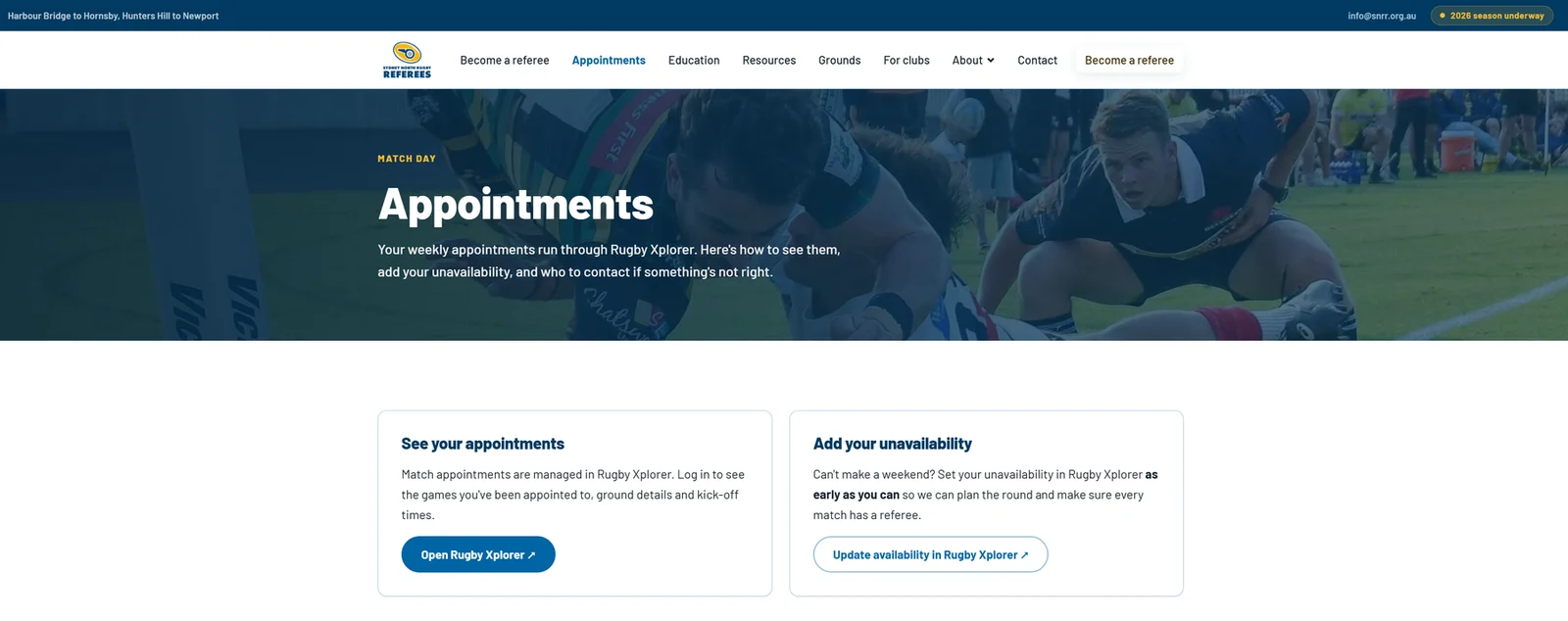
Sydney North Rugby Referees
The same method, second time. Live at snrr.org.au.
The problem
The association was paying commercial hosting fees out of a volunteer budget for a website nobody could easily update. Email ran on personal accounts tied to individuals, so when a committee position changed hands the history went with the person. Referee registration, appointments, accreditation and education records lived across spreadsheets and inboxes.
A referee association is not a club, and treating it like one is the usual mistake. The domain model is referees, appointments, education and accreditation, not teams, sponsors and fixtures.
What was built
Identity first
Role accounts rather than personal accounts, so the president mailbox is the president mailbox regardless of who holds the position. Security groups for authorisation, break-glass administrative access, and a documented handover ritual for when a role changes hands.
Email and domain
Email migrated to the platform with history brought across, cut over in a single evening. DNS and domain brought under platform management using the pattern proven on the first build.
A public website
With a committee area gated by platform role invitation rather than a shared password. Content is fed from SharePoint so committee members publish without touching code.
An appointments engine
Designed and being built. Referee register with accreditation, grade, working-with-children status and playing club, the last of these so the system can detect a conflict before an appointment is made. Every district fixture classified for scope. One appointment record per official per game. An auto-suggest pass proposes a weekend's appointments for the appointments officer to accept or reject, rather than replacing the judgement.
Automation and operations
Build pipelines, weekly digests, compliance tracking and cost alerting, reusing the patterns already proven.
How it is built
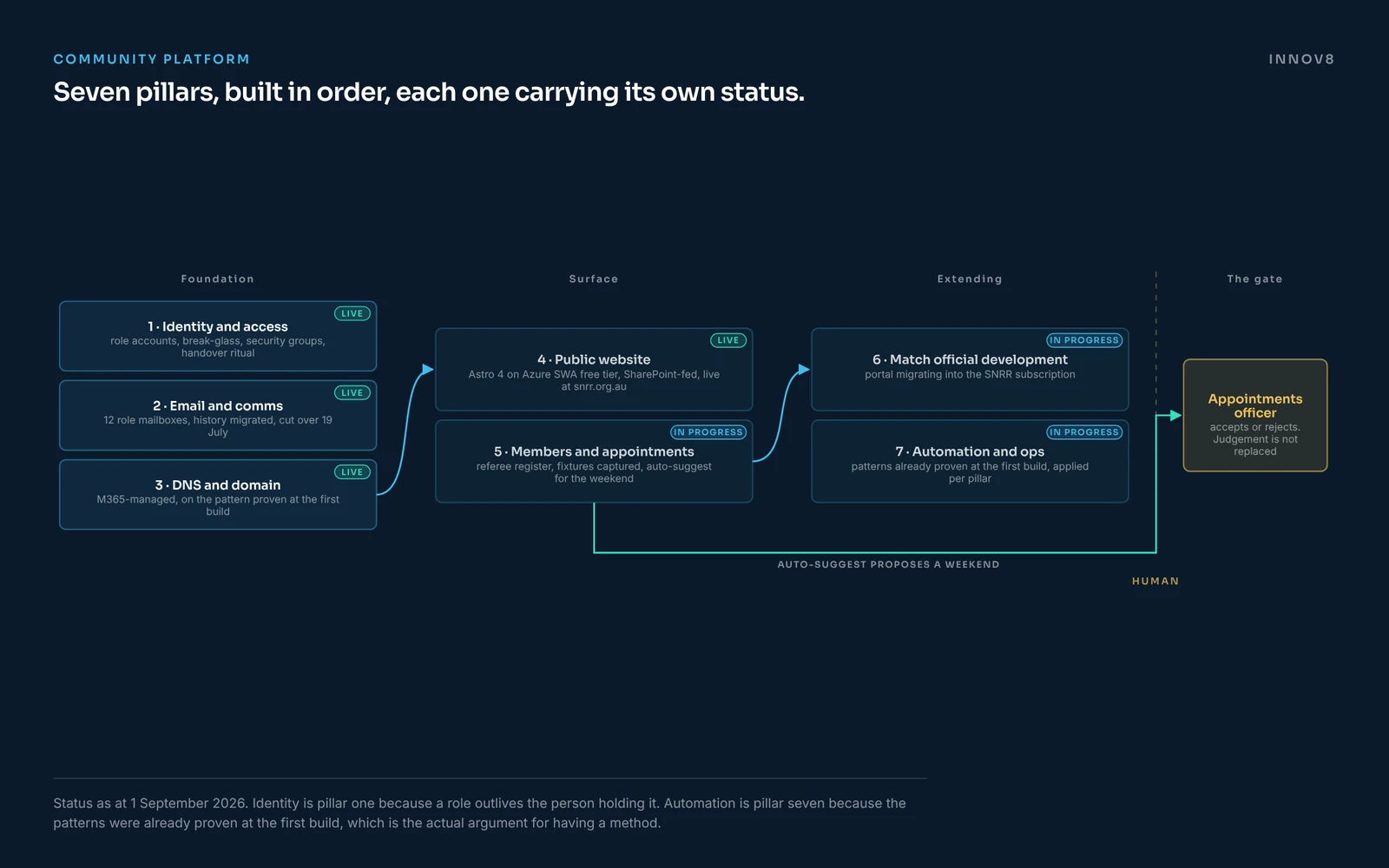
The seven pillars, in build order, each carrying its own status.
The same stack. Not-for-profit grant licensing, SharePoint lists as the data layer with no new databases, cloud free tiers, everything static and built at deploy time. No hardcoded identifiers or content, because configuration lives in SharePoint and secrets live in the pipeline.
The second build took a fraction of the time of the first. That is the actual argument for having a method.
Finance Engine
Evidence in, one canonical model, a rule proposed, and a human deciding.
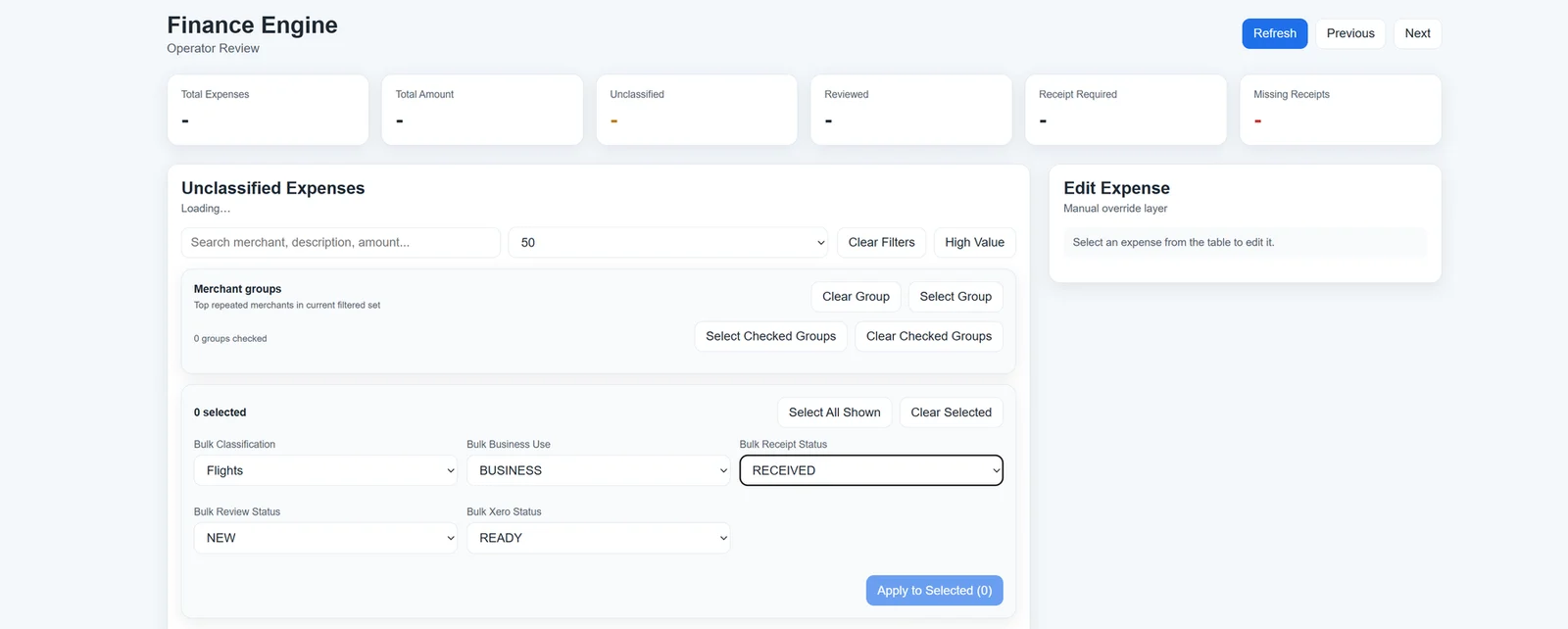
The practice's own financial operating system. Evidence intake, a canonical transaction model, a rule engine that proposes and a human that approves, and a reconciliation pass that reports variance month by month.
No financial figures are published, because the same system carries personal as well as company records.
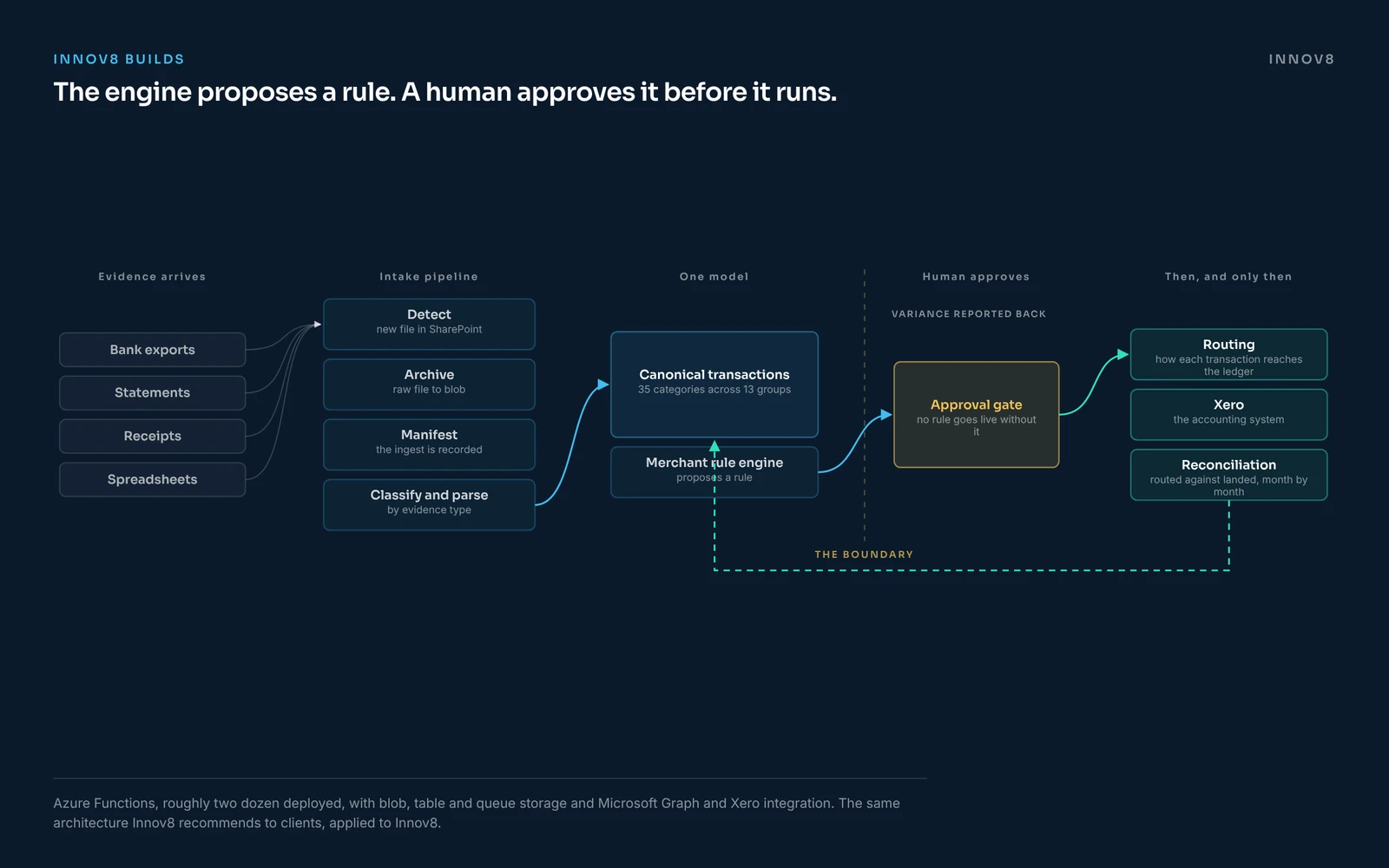
Evidence in, one canonical model, a rule proposed, a human approving, and only then the ledger.
What the three have in common
Zero marginal platform cost on the community builds
Both run entirely on grant and free tiers. Neither organisation acquired a new vendor relationship.
No developer required to operate
Volunteers publish by sending an email or editing a list. Nothing routine requires code.
Configuration over code
Competition rules, minimum accreditation requirements, committee membership and site content live as data. Seasons change without a deployment.
Compliance as a running system
Accreditation and screening status is checked continuously and escalated before it becomes a match-day problem, not audited annually.
Privacy designed in
Consent models, human review gates before publication, contact details scoped to the audience that needs them, and explicit decisions about children and historical records rather than defaults.
The same governance as a commercial programme
Standards defined before build, a gate before deployment, provenance on every derived fact, and rollback planned before execution.
The pattern is portable
Most community and sporting organisations are paying for hosting they do not need, running compliance on spreadsheets, and losing their institutional record every time a committee turns over. The grant tiers that fix that already exist and are usually unclaimed.
The same pattern, at enterprise scale, is what the rest of this site is about.