The Intent
Delivery goes wrong at the seams.
What Innov8 believes about delivery, and how it makes it real, from the systems and the parties you already have.
The intent
Delivery goes wrong at the seams. Between the systems, where the schedule says one thing, the procurement platform another and the site a third, and a person spends the week reconciling them by hand. And between the parties, because a build of any scale is delivered by many organisations, none of whom see the whole.
The information exists. It is just not connected.
Innov8's intent is one live, connected source of truth for a delivery, across the systems and across the parties, so everyone from the working team to the board is looking at the same reality, and looking at it now. Informed, not discovered.
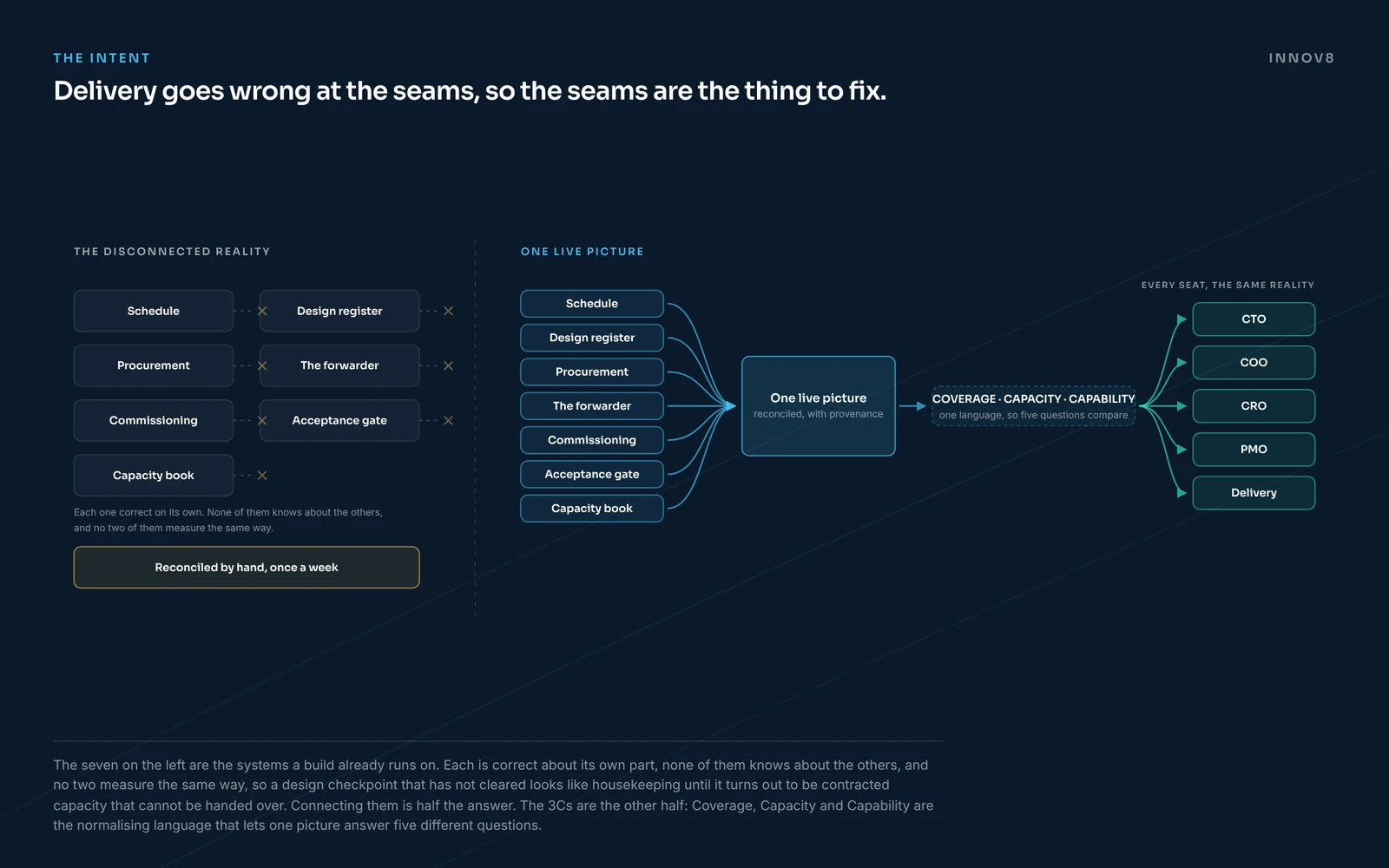
The seven systems a build already runs on, and the same seven connected. Coverage, Capacity and Capability are the language that lets one picture answer five different questions.
One delivery team
An AI factory is not built by one organisation. The owner sits at the centre of an ecosystem: the data centre builder, the vendors, some direct and some through the channel, the contracted resources and third parties, and the multi-role players who are integrator, reseller and advisor on the same job at once. Every party runs its own systems, holds its own contract and sees only its own part. The seams between them are where delivery fails.
The intent welds them into one delivery team: a single connected source of truth across every party, and clear roles, responsibilities, inputs and outputs across organisational boundaries, so a dozen contracted parties operate as one team against one picture.
No single party's tool can do this, because a tool stops at that party's edge. A neutral operator, with an approach that sits on everyone's stack, can.
How it works: connected sources of truth
We connect each layer of a delivery, from the physical infrastructure up through the cloud, and integrate with the tools each layer already runs on: the element and infrastructure management systems, the project and delivery tools, the CMDB, the operations tooling, the telemetry. Every connection adds another source of truth and another live status.
We extend the same principle to the supply chain, both the equipment, through procurement and logistics, and the resources, through people, skills and availability, and across the parties who own each part.
With it all connected, AI enablement sits over the whole picture. It dimensions the team, defines clear roles, responsibilities, inputs and outputs across the parties, and surfaces status, risk and the real critical path.
And the design thread stays alive, the high and low level designs becoming a living bill of materials, assemblies, tests and controls, rather than static documents that are true only on the day they are signed.
What you are buying, and what you are not
You are not buying a platform to adopt. The strategic portfolio management platforms are good at what they do, but their model, in their own words, is to bring your existing investments onto their platform. You migrate onto it, you license it, and you are left to run it. That is the trap: a tool that arrives with its own opinion about how you should work, and belongs to one party.
You are buying an intent, an approach, and an operator. We work on the systems and the parties you already have, and we act as the architect. For each capability the delivery actually needs, we make the call: build it, buy it, or integrate what is already there.
Where you run ServiceNow for your CMDB and change, that is a component we build on, not something we replace. Nothing gets thrown away.
We work out what is needed and assemble it, tuned to your intent, all the way up to the views your stakeholders, your C-suite and your board need, built around the questions leaders actually ask: what does good look like, are we there yet, are we ready.
Two situations, one engine
The same engine points at two very different jobs. It is one approach tuned to two intents, not two separate tools.
Greenfield
A greenfield AI factory
When the job is to build a neocloud or AI factory from dirt, the engine stitches the design and bill of materials, procurement, logistics, the physical build, the network fabric, the liquid-cooling loop, commissioning and the commercial book into one live picture, across every party delivering it.
An uncleared control becomes megawatts of sold-at-risk capacity before it becomes a missed handover.
Run this way, the build behaves like a factory: long-lead plant, the transformers, switchgear and gensets, is reserved and committed before the design is frozen, the physical work proves itself as it is installed, and spare capacity that is built but not yet sold loops back to the front to be sold.
Live estate
A live, multi-site estate
When the job is not a greenfield build but evolving a customer who is already running, across many sites, the same engine becomes the Platform Control Centre. New technology and new initiatives are proven against a digital twin before they touch a running site, gated by architecture control and deployment control, normalised by the 3Cs, Coverage, Capacity and Capability.
Operations feed telemetry, the CMDB and the ops and network systems back into the picture, and an agentic layer turns it into an executive view of progress and risk. A closed loop that lets a live estate evolve safely, on the operating windows the business depends on.
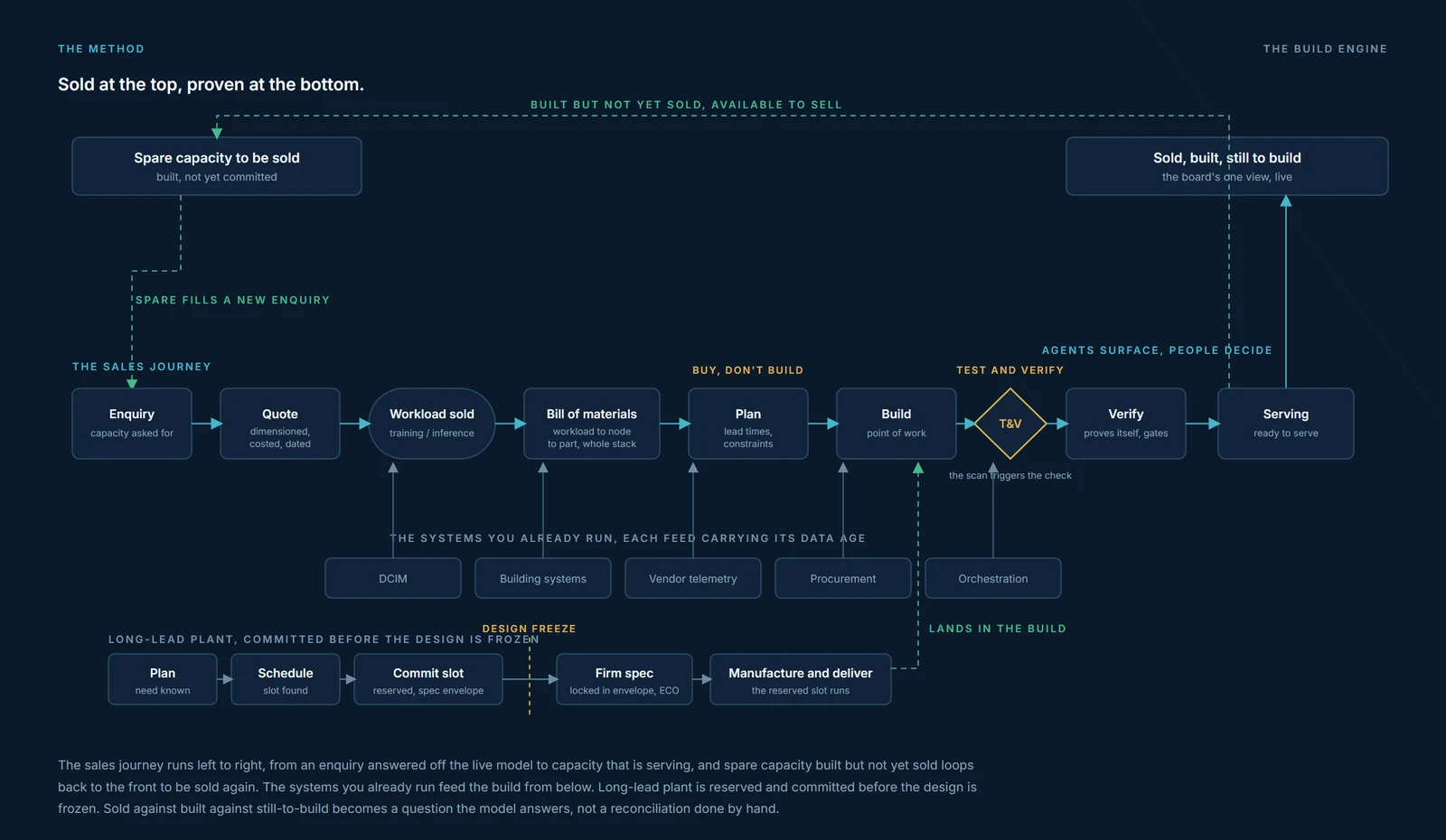
The greenfield case, drawn out. Sold at the top, proven at the bottom, with long-lead plant committed before the design is frozen.
The commercial model
There is no SKU and no licence fee, because it is not software. It is engaged, contracted, run pay-as-you-go, or onboarded as a Head of or a VP with short and long-term incentives.
The same intent is a consulting offer and a senior-role mandate, and a client chooses the shape that suits them.
Who runs it
An intent is only as good as the operator who owns it, and that is also the honest answer to who Marcus Stock is. What he can do is deliver this. What he has done is the evidence for it, thirty years of infrastructure, data centre and network programmes across health, finance, government, telco and retail, on both sides of the integrator table. What he thinks is the point of view, published as Innov8 Insights.
The model and the operator are the same pitch.